
EU AI Act · Article 99
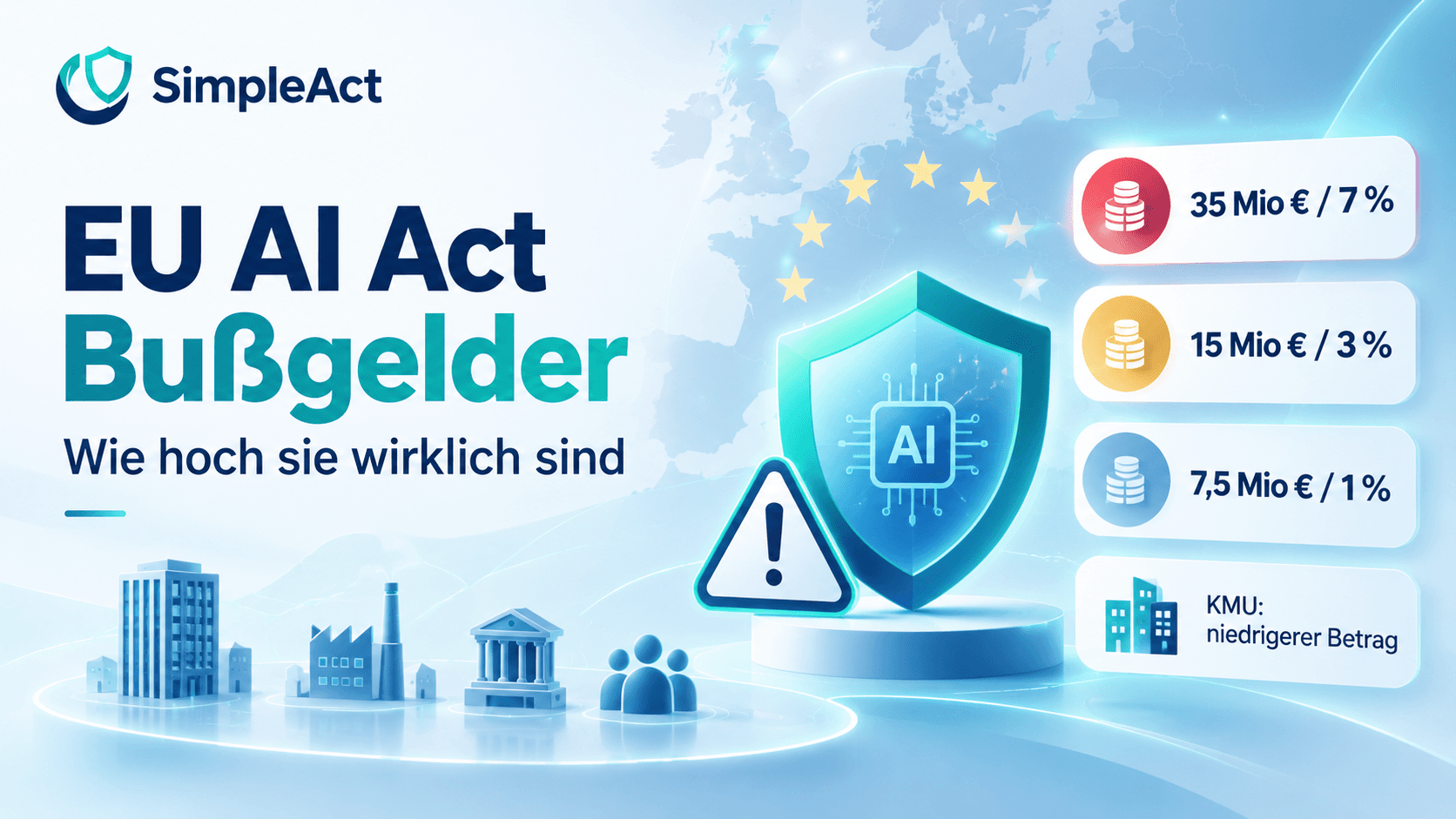
€35 million. That figure appears in almost every article about the AI Act. For a mid-sized company it is misleading, for a reason most of those articles leave out.
The penalty provisions of the AI Act have applied since 2 August 2025. Since 2 August 2026, market surveillance in Germany has been carried out by the Federal Network Agency. The question of how high the fines are has moved from theoretical to practical.
The short answer: for the vast majority of European companies the ceiling is not €35 million but a single-digit percentage of their own turnover. The reason sits in Article 99(6), and it is rarely mentioned alongside the headline number.
The three tiers of the penalty framework
Article 99 grades penalties by the severity of the breach. On top of that sits a separate framework for providers of general-purpose AI models, enforced by the Commission itself.
The general rule: whichever of the two figures is higher applies. That is exactly where the exception below comes in.
The reversal for SMEs
Article 99(6) inverts the rule for small and medium-sized enterprises including start-ups: for them, whichever figure is lower applies. Not the higher one.
This is not a footnote. It is the difference between a company-ending sum and a painful one. A worked example for a mid-sized company with €12 million in annual turnover:
Prohibited practice
€840,000
7 % of €12m instead of €35m
Deployer or Art. 50 duty
€360,000
3 % of €12m instead of €15m
Incorrect information
€120,000
1 % of €12m instead of €7.5m
The amounts still sting. But they sit in a range a company survives, and all of them are ceilings, not standard rates. An SME here means fewer than 250 employees and no more than €50 million in annual turnover or €43 million in balance sheet total.
New since July: the rule for small mid-caps
The Digital Omnibus added a paragraph 6a to Article 99. It extends the reversal to small mid-cap companies, meaning companies that are no longer SMEs but employ fewer than 750 people and stay within €150 million in turnover or €129 million in balance sheet total. In Germany alone that covers roughly 18,000 companies previously treated like large corporations.
The detail that matters
The new small mid-cap rule refers only to paragraphs 4 and 5, not to paragraph 3. For prohibited AI practices, these companies remain subject to the higher figure and therefore potentially to €35 million. For SMEs the reversal applies across all three tiers. Treating the two categories as equivalent underestimates the exposure of larger mid-sized companies at the most sensitive point.
In addition, paragraph 1 obliges Member States to take into account the interests of SMEs, start-ups and small mid-caps, and their economic viability, when imposing penalties.
What is actually punishable, and what is not
Not every obligation in the AI Act carries a penalty. The catalogue in paragraph 4 is exhaustive, and two entries deserve attention.
Newly added: Article 25
The Omnibus brought the obligations under Art. 25(2) and (4) into the penalty catalogue. That covers the case where a company slides into the provider role along the value chain, for instance by offering a system under its own name or substantially changing its purpose.
Not in the catalogue: Article 4
The AI literacy duty has no dedicated penalty provision. It is enforceable only through national law, and it becomes practically relevant when an incident traces back to inadequate training.
How the actual amount is arrived at
The figures in the table are ceilings, not price tags. Article 99(7) lists ten criteria that determine the real amount. Four of them a company can influence itself, and it has to do so before anything happens.
The technical and organisational measures in place
The degree of responsibility is expressly assessed in light of what the company did preventively. A maintained system inventory with documented responsibilities is therefore not an end in itself but a factor in the calculation.
How the authority learned of the breach
Whether and to what extent the company reported the breach itself counts explicitly. Self-reporting mitigates; discovery by a third party does not.
The degree of cooperation with the authority
A company that can answer a request for information in a structured way within days is in a different position from one that first has to spend weeks working out which AI is even in use.
Intent or negligence
A documented, even if incomplete, compliance process argues against intent. The absence of any engagement with the topic argues that the breach was accepted as a possibility.
Alongside these sit criteria outside a company's control: the nature, gravity and duration of the breach, the number of people affected, the size and market share of the operator, and any financial gains obtained.
Who enforces this in Germany
The German AI Market Surveillance and Innovation Promotion Act, known as KI-MIG, entered into force on 29 July 2026. The Bundestag adopted it on 11 June, and the Bundesrat waived the mediation committee on 10 July.
The central market surveillance authority, contact point and complaints office is the Federal Network Agency (Bundesnetzagentur). It has been conducting market surveillance since 2 August 2026 and is responsible in particular for sector-neutral applications, expressly including AI in human resources, critical infrastructure and education. Its coordination and competence centre, KoKIVO, sits within the agency. Sector responsibility remains with BaFin, the BSI, the BfArM and the federal data protection commissioner.
Practical note: the Federal Network Agency runs a free service desk for companies. If you are unsure how to classify a system, you can ask there rather than guess. For an SME that is the cheapest advice available.
The fine is often not the most expensive consequence
Market surveillance authorities can demand more than money. They can order corrective measures, restrict placing a system on the market, and prohibit its use.
For a company whose customer service runs on an AI assistant, or whose quoting process depends on a model, an ordered shutdown is usually more damaging commercially than a fine in the mid five figures. Add to that the possibility of proceedings becoming public, and the fact that since August competitors and affected individuals have an official route to report breaches through the complaints office.
The point that matters
"How high is the fine" is a misleading question, because it assumes a fixed number. In reality the amount depends on company size, the provision breached, and a list of ten criteria, several of which hang directly on your own documentation.
A company that can show which AI systems it uses, which role it holds for each and who is responsible improves its position three times over: on the question of intent, on the degree of cooperation, and in the assessment of the measures taken. That is the difference between the top and the bottom of the same range.
With SimpleAct
Be able to answer before anyone asks.
EU AI Act and GDPR in one platform: register AI systems centrally, classify them rule-based, assign responsibilities and export audit-ready evidence at any time. Made in Germany, hosted in Germany.
Start your AI inventory →This article is for general information only and does not constitute legal advice. Last updated: 9 September 2026.
Tags
Ready to put EU AI Act compliance on autopilot?
SimpleAct helps you inventory AI systems, classify risk, and structure and keep the required documentation up to date.
Yannick | SimpleAct Team
Author · SimpleAct Team