
AI Phone Assistants Are More Than Just Telephony
Why Voice AI Becomes an AI Governance Topic
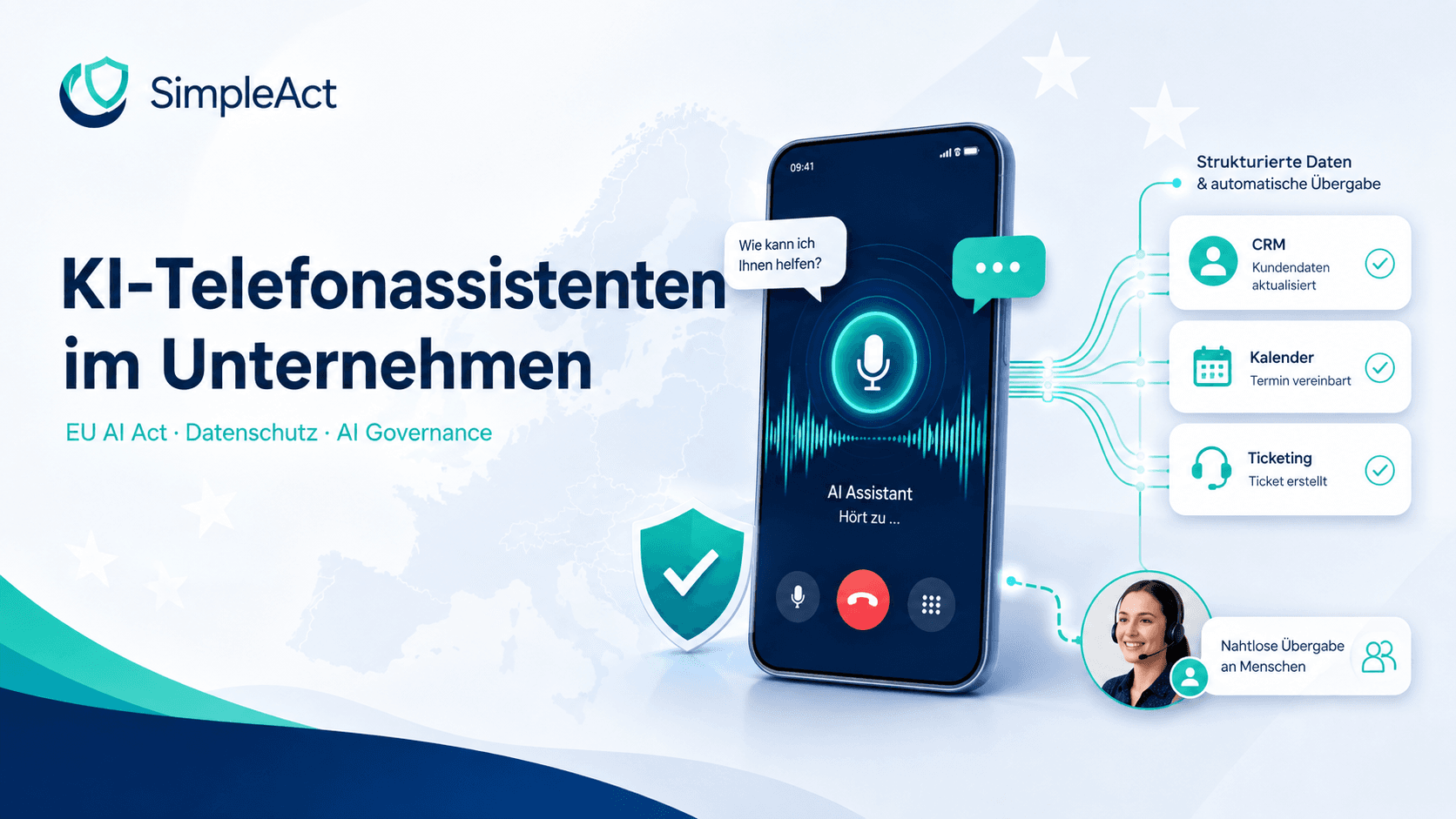
AI phone assistants are no longer just digital answering machines. They can receive calls, understand requests, collect contact details, coordinate appointments and pass information to CRM, calendar or ticketing systems.
This means that a telephony tool can quickly become an AI system that is connected to existing business processes and data flows.
Companies therefore need to answer several questions at the same time: Which requirements of the EU AI Act apply? Which personal data is processed? Who is responsible? And how should the system be documented and controlled?
Since 2 August 2026, the transparency obligations under Article 50 of the EU AI Act apply. For interactive AI systems such as AI phone assistants, it is particularly relevant that people generally need to be informed when they are directly interacting with an AI system.
Important: An AI phone assistant is not automatically a high-risk AI system. What matters is not only the technology being used, but the specific purpose for which the system is used.
Risk Classification Based on the Actual Use Case
Classify the Process, Not the Interface
Two technically similar AI phone assistants can have completely different regulatory classifications.
One system may only provide opening hours, arrange appointments, collect callback requests or forward enquiries to an employee.
Another Voice AI system may analyse information about individuals and use that analysis in a sensitive decision-making process.
For risk classification, the label “AI phone assistant” is therefore not decisive. The key factors are the purpose, function and specific context of use.
Example for the AI inventory: “Telephone-based first-line handling of customer requests, collection of the request, appointment scheduling and transfer of relevant information to the CRM.”
Transparency Obligations Under Article 50
People Need to Know When They Are Interacting With AI
Article 50(1) generally requires providers of AI systems intended for direct interaction with natural persons to design and develop these systems in a way that informs the affected persons that they are interacting with an AI system.
An exception applies where this is obvious to a reasonably well-informed, observant and circumspect person, taking into account the circumstances and the context of use.
The required information must be provided clearly and unambiguously no later than the first interaction.
Practical example: “Hello, you are speaking with our AI-powered phone assistant.”
Distinguishing Between Provider and Deployer
Who Is Responsible for What?
For a proper compliance assessment, it is important to distinguish between the different roles under the EU AI Act.
The provider develops or places the AI system on the market under the conditions of the AI Act.
The deployer uses the AI system under its own responsibility.
When a company uses an external Voice AI solution, different obligations may therefore apply to different organisations.
For proper AI Governance, companies should document which role they have in the specific scenario and which requirements result from that role.
When Can Voice AI Become a High-Risk System?
The Intended Purpose Is What Matters
A phone assistant does not become a high-risk AI system simply because it processes natural language or conducts conversations automatically.
High-risk classification may become relevant where the system is used in a sensitive area covered by the AI Act for specific evaluations or decisions.
This may include certain use cases in employment processes or certain essential private services.
Key principle: Classify the actual process, not the interface.
Data Protection and AI Phone Assistants
Which Data Flows Through the Conversation?
Regardless of the AI Act classification, the GDPR may also apply.
During a phone call, personal data such as names, phone numbers, email addresses, customer numbers, conversation content, transcripts, summaries or structured information for CRM and ticketing systems may be processed.
Depending on the use case, special categories of personal data may also be involved. For example, callers speaking with an AI phone assistant in a medical practice may provide health-related information.
Data Minimisation Starts During the Conversation
Only Collect What Is Really Needed
Data protection in Voice AI is not only a question of the privacy policy.
The design of the conversation itself also influences which data is created in the first place.
If only the caller's name, phone number and request are needed for a callback, the phone assistant should not collect additional personal information without a clear reason.
Our tip: Assess audio, transcripts, summaries and structured result data separately. For each stage, it should be clear whether the processing is really necessary and how long the information needs to be stored.
What Should Be Documented?
The Most Important Governance Information in One Place
A governance record does not necessarily need to be a hundred-page document.
What matters is that the relevant information is recorded in a traceable way and can be updated when changes occur.
1. System and provider. Which AI phone assistant is being used?
2. Business purpose. What specific task does the system perform?
3. Responsible person. Which department and which person are responsible internally?
4. AI Act role. Is the company acting as provider, deployer or in another role?
5. Affected persons. Customers, patients, applicants, suppliers or other groups.
6. Data categories. Which personal or other data is processed?
7. Integrations. Which CRM, calendar, ticketing or other systems are connected?
8. Storage and deletion. What is stored and for how long?
9. Transparency. How are people informed about the use of AI?
10. Escalation. When does a human take over?
11. Risk classification. Which AI Act classification was assigned and why?
12. Review. When was the assessment last reviewed?
Human Takeover and Escalation
When Should the Phone Assistant Transfer the Conversation to a Human?
Not every conversation should be fully automated.
Especially for complex, sensitive or unusual cases, it makes sense to define clear limits for the AI phone assistant.
Possible escalation cases include complaints, security-related reports, legally sensitive questions, medically sensitive topics or situations where the assistant repeatedly fails to understand the caller's intent.
Our tip: Define typical edge cases and regularly test whether forwarding, notifications and human takeover actually work as intended.
Practical Example: Teloro
How a Specific AI Phone Assistant Can Be Documented
One example of the practical use of such systems is Teloro GmbH from Mannheim, Germany. Teloro develops AI phone assistants for businesses that can handle incoming calls, understand requests in natural language, ask targeted follow-up questions and prepare information in a structured format for further business processes.
Depending on the specific use case, the system can support processes such as appointment requests, callbacks, call forwarding or the transfer of relevant information to calendars, CRM systems or other downstream systems.
Teloro is mainly used for initial telephone handling and structured qualification of incoming requests. From an AI Governance perspective, however, the specific use in the company matters more than the product name itself.
Example for the AI inventory: “Use of Teloro as an AI phone assistant for automated first-line handling of incoming calls, collection and qualification of requests, and transfer of relevant information to downstream systems.”
Companies can then systematically assess which data is processed, which systems are connected, which transparency measures are required and where human responsibility remains necessary.
Voice AI should not be treated as an isolated telephony tool.
As soon as information from a conversation flows into other company systems, a broader business process is created that should be assessed as a whole.
More information is available from the AI phone assistant from Teloro.
A Practical Rollout in Seven Steps
From Initial Selection to Ongoing Monitoring
1. Define the use case. Which tasks should the AI handle, and which tasks should it explicitly not handle?
2. Register the system. Add the AI system to the central inventory and assign responsibilities.
3. Perform the AI Act assessment. Determine the role and risk classification based on the specific intended purpose.
4. Assess data flows. Document personal data, recipients, providers, integrations, storage and deletion.
5. Define transparency and escalation. Set clear notices and system boundaries.
6. Test. Test normal use cases as well as edge cases before production use.
7. Monitor and reassess. Track changes to the system and its intended purpose.
Why a One-Time Assessment Is Not Enough
AI Systems Change After Go-Live
An often underestimated challenge starts after go-live.
A new CRM integration may be added. The phone assistant may suddenly collect additional data. A knowledge base may be expanded. A new model may be introduced. The original use case may be extended to additional departments.
As a result, the compliance context can also change.
AI Governance should therefore not be treated as a one-time approval before go-live.
Changes to purpose, data flows, models, integrations and responsibilities should remain traceable and, where appropriate, trigger a new assessment.
From Documentation to Continuous AI Governance
Why a Structured AI Inventory Is the Foundation
Companies do not only need to know which AI systems exist, but also:
What do they do?
Who is responsible?
Which data do they process?
Which regulatory requirements apply?
When were they last reviewed?
A platform like SimpleAct can bring this information together in one place and connect AI Act classification, GDPR-relevant information, responsibilities, evidence and later reassessments.
The goal: Even six months after implementation, a company should still be able to understand how an AI system is being used, why it received its regulatory classification and what has changed since then.
Frequently Asked Questions About AI Phone Assistants
EU AI Act and GDPR Explained Briefly
Does an AI phone assistant need to say that it is AI?
For AI systems intended for direct interaction with natural persons, Article 50(1) generally provides for a transparency obligation on the provider. An exception applies where the AI interaction is obvious based on the circumstances and context.
Is an AI phone assistant automatically a high-risk AI system?
No. The specific intended purpose is the key factor. An assistant used for appointment scheduling or routing does not become high-risk simply because AI technology is used.
Does the GDPR also apply?
If personal data is processed, the GDPR must also be considered. Voice systems may process contact details, conversation content, transcripts, summaries or particularly sensitive information.
What should be documented?
Companies should document the purpose, provider, responsibilities, data flows, integrations, affected persons, transparency measures, escalation processes and the AI Act assessment in a traceable way.
Does every conversation need to be stored or transcribed?
No. Whether audio, transcripts or summaries are stored depends on the technical setup and the specific purpose.
Conclusion
The Phone Assistant Is a Process, Not an Isolated Tool
AI phone assistants can improve availability and automate repetitive communication processes. From a regulatory perspective, however, companies should not treat them as simple telephony software.
Since 2 August 2026, the transparency obligations under Article 50 of the EU AI Act are particularly relevant. At the same time, the GDPR may apply whenever personal data is processed.
The key question is therefore not:
“Do we use an AI phone assistant?”
But rather:
“What exactly does this AI system do in our company, which data and processes does it affect, and who is responsible for it?”
Companies that can answer these questions from the beginning and keep the answers up to date create a strong foundation for scalable AI Governance.
This is exactly where SimpleAct comes in: identify, classify and document AI systems in one place — clearly structured, traceable and without spreadsheet chaos.
This article is provided for general information only and does not constitute legal advice. The specific legal assessment depends on the AI system, its intended purpose, the allocation of roles and the data processing involved. In case of uncertainty, we recommend obtaining legal advice.
About SimpleAct: SimpleAct is a German compliance platform that helps companies systematically identify, assess and document their AI systems and manage relevant requirements under the EU AI Act and GDPR.
Tags
Ready to put EU AI Act compliance on autopilot?
SimpleAct helps you inventory AI systems, classify risk, and generate the required documentation automatically.
Kamill Jarzebowski | SimpleAct
Author · SimpleAct Team