
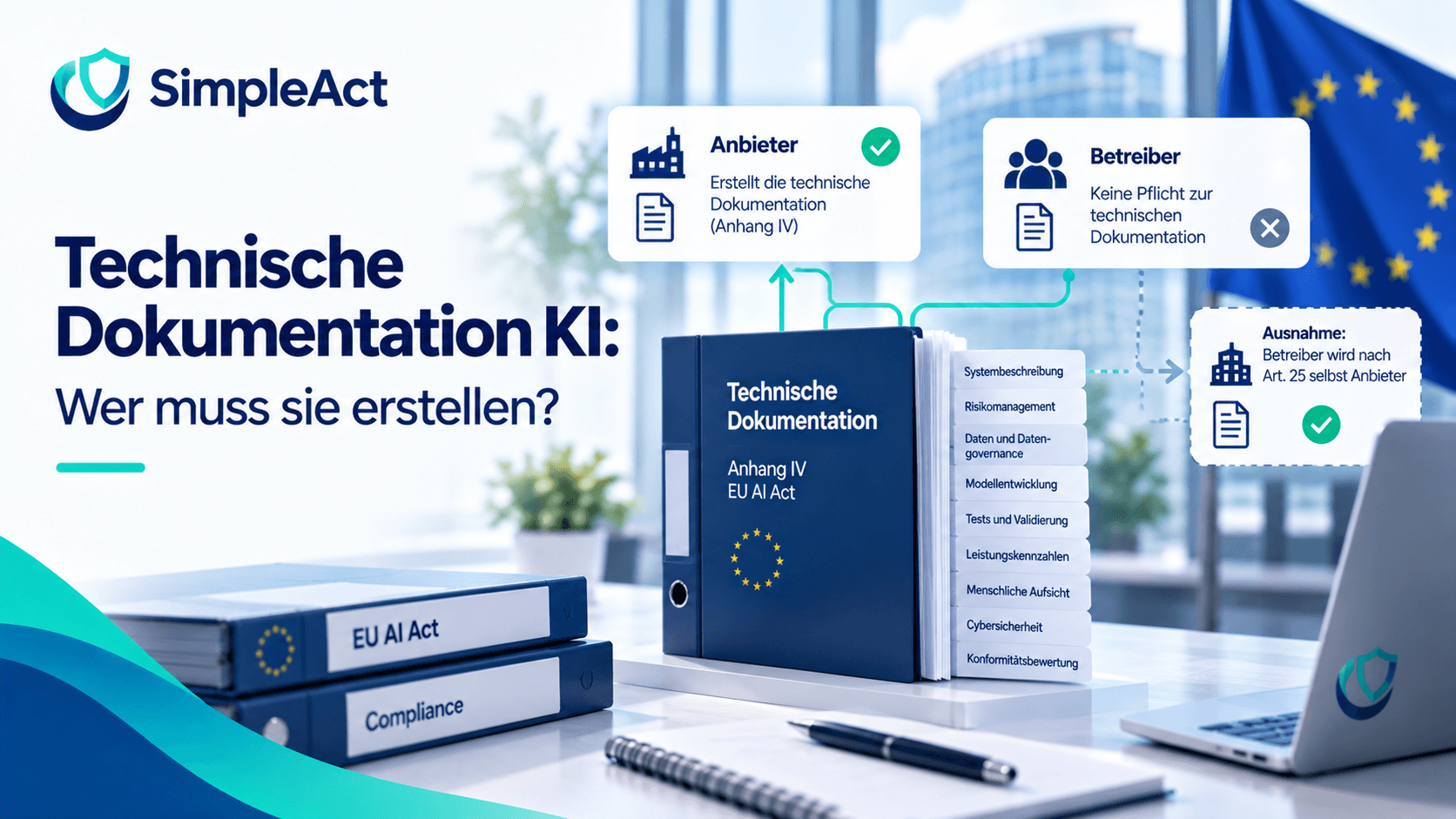
EU AI Act technical documentation: Who must prepare it?
Is technical documentation a matter for the deployer?
EU AI Act · Annex IV
Technical documentation under Annex IV is a duty of providers. If you only use a high-risk system, you generally do not have to prepare it.
Technical documentation under Art. 11 and Annex IV of the AI Act is a duty of providers of high-risk AI systems (Art. 16(a) in conjunction with Chapter III Section 2). It must be prepared before the system is placed on the market or put into service and kept up to date.
It does not fall on deployers, unless they become providers themselves under Art. 25. This article clarifies the question of roles. The content of Annex IV is described on our page about technical documentation under Annex IV.
Providers
Duty
Technical documentation under Art. 11 and Annex IV, to be prepared before placing on the market and kept up to date.
Deployers
Not covered
Unless they become providers themselves under Art. 25.
Who is responsible for technical documentation?
Responsibility follows the role, not the use of the system.
If you want to place yourself as a deployer, the key obligations are on our page about deployer obligations under the AI Act.
When do you become a provider yourself as a deployer?
Art. 25(1) names three cases in which distributors, importers, deployers or other third parties are considered providers of a high-risk AI system. They are then subject to the provider obligations under Art. 16.
Your own name or trademark
You put your name or trademark on a high-risk AI system that has already been placed on the market or put into service.
Substantial modification
You substantially modify a high-risk AI system and it remains high-risk.
Changed intended purpose
You change the intended purpose of a system that is not high-risk so that it becomes high-risk. This expressly includes general-purpose AI systems.
Whoever becomes the provider of a high-risk AI system in this way must also prepare the technical documentation (Art. 16(a), Art. 11). The duty applies from 2 December 2027 or 2 August 2028 respectively.
Do deployers have to prepare the technical documentation?
This question comes up in every roll-out of a high-risk system.
Common misconception
“If you use a high-risk AI system, you have to prepare the technical documentation under Annex IV.” The correct position: technical documentation is a provider duty. It does not fall on deployers, unless they become providers themselves under Art. 25.
Deployers have other obligations. For example, they keep the logs automatically generated by the system, to the extent they are under their control, for a period appropriate to the intended purpose, at least six months unless provided otherwise (Art. 26(6)).
From when does the duty apply, and what changes for SMEs?
The duty applies from 2 December 2027 for high-risk systems under Annex III and from 2 August 2028 for systems under Annex I. The Omnibus set these dates.
2 December 2027
Annex III: high-risk obligations, including technical documentation.
2 August 2028
Annex I: high-risk obligations for systems in product safety law.
Since the Omnibus there is a relief for SMEs and small mid-caps: they may provide the technical documentation in a simplified way through a form of the Commission (Art. 11(1) second subparagraph as amended). Whoever chooses this must use the Commission form, and notified bodies accept it.
Four steps to clarify responsibility
The steps are a recommendation. The regulation does not prescribe a sequence.
Record systems and intended purpose
Which AI systems do you use, and what are they intended for?
Assign a role per system
Are you a provider or a deployer? That decides on the technical documentation.
Check for a change of role
Do the systems carry your name or trademark? Have you substantially modified them or changed their intended purpose?
Plan the documentation if you are a provider
Use the structure of Annex IV and decide who prepares it and keeps it up to date before the date of application.
The point that matters
Whether you have to prepare the technical documentation is decided not by use but by role. Most of the time it sits with the provider.
For your own planning it matters whether a trademark, a modification or a new intended purpose makes you a provider. That can only be clarified if role and purpose are recorded for each system.
With SimpleAct
Record role and purpose for each AI system in one place.
EU AI Act and GDPR in one platform: record AI systems centrally, classify them by rules, assign responsibilities and export audit-ready evidence at any time. Made in Germany, hosted in Germany.
Record your AI systems now →Sources
Regulation (EU) 2024/1689 (AI Act), Art. 11, 16, 25, 26, Annex IV · Regulation (EU) 2026/1744 (Digital Omnibus on AI), Art. 1 point 40
This article is for general information only and does not constitute legal advice. Last updated: 11 October 2026.
Tags
Ready to put EU AI Act compliance on autopilot?
SimpleAct helps you inventory AI systems, classify risk, and generate the required documentation automatically.
Yannick | SimpleAct Team
Author · SimpleAct Team